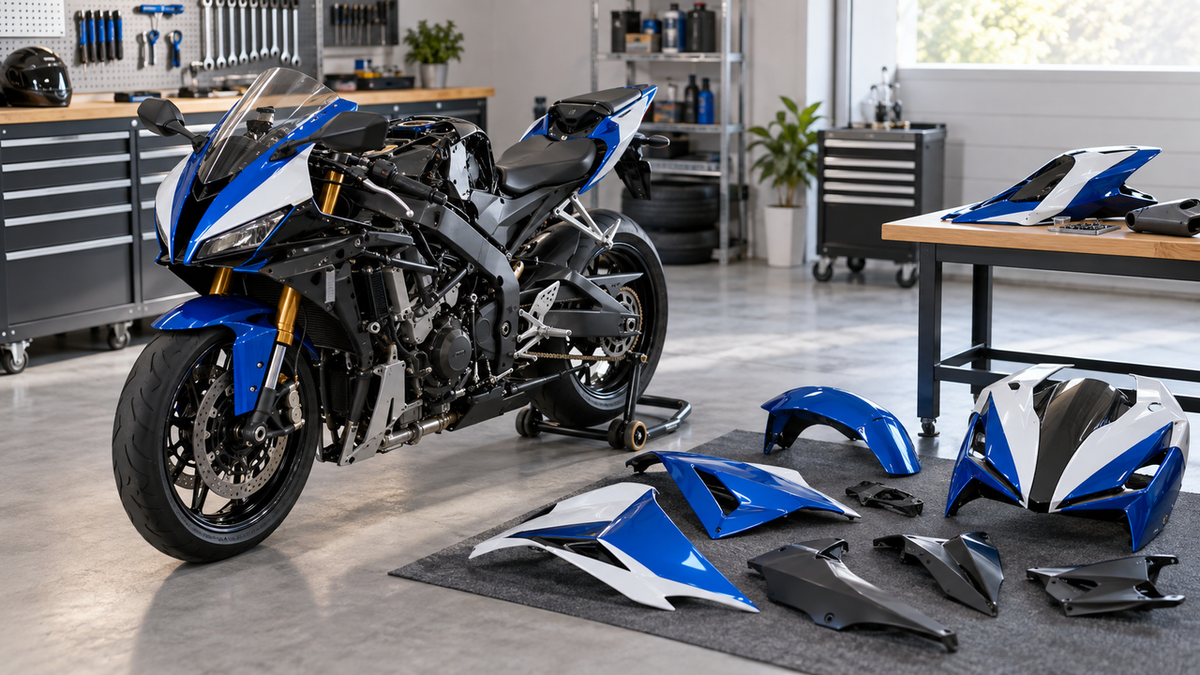

Should I buy ABS or fiberglass motorcycle fairings if I need durable street bike replacement bodywork?
Direct answer: For most street-bike replacement projects, buy a model-specific ABS fairing kit. ABS is generally the more practical choice when the motorcycle must retain street-oriented panel shapes, lights, ducts, inner-panel interfaces, and regular service access. Choose fiberglass when the build is track-first, heavily customized, or supported by a repair-and-refinish workflow that accepts sanding, resin work, drilling, and repainting. Do not choose by material name alone: panel geometry, mounting-point support, heat clearance, fastener installation, and the condition of the motorcycle underneath the bodywork can matter more to long-term durability than the word “ABS” or “fiberglass.”
This guide focuses on durable replacement bodywork for a motorcycle that will spend most of its time on public roads. It does not treat every ABS kit as equal or every fiberglass panel as fragile. Instead, it explains which material usually fits a street rebuild better, when fiberglass is still the smarter route, and how to check the details that determine whether either choice will last.
|
Rider or rebuild need
|
Better starting point
|
Reason
|
Verify before buying
|
|---|---|---|---|
|
Daily street riding with factory-style equipment
|
Model-specific ABS
|
Street-oriented panel layout and a more direct replacement workflow
|
Exact model, year range, variant, openings, panel count, and transferred parts
|
|
Several damaged street panels need a coordinated replacement
|
Painted ABS full kit
|
One set can provide consistent panel geometry and finish across the bike
|
Mounting structure, included pieces, color expectations, and test-fit process
|
|
Exact local color match or artist-led finish
|
Unpainted ABS plus a qualified painter
|
Separates bodywork fitment from final paint control
|
Surface preparation, dry fit, painter responsibility, and correction process
|
|
Dedicated track or race project
|
Purpose-built fiberglass race bodywork
|
Race-oriented layouts can prioritize repeated repair and refinishing
|
Event rules, fasteners, light openings, lower-fairing design, and mounting method
|
|
One isolated damaged panel
|
Repair or one verified replacement panel
|
A full kit may add cost and finish-matching work that the repair does not need
|
Neighboring edges, tabs, brackets, graphics, and paint age
|
Why ABS Is Usually the Better Street Replacement
ABS is a thermoplastic used for complex molded shapes. In a street fairing application, its main advantage is not a universal promise that it will survive every impact. Its advantage is that it can be manufactured as a model-specific system with the shapes and interfaces expected around headlights, ducts, inner panels, windscreens, mirrors, and other road equipment.
That makes ABS the simpler starting point for a street motorcycle that needs replacement bodywork rather than race conversion. A compatible kit can also be supplied painted or unpainted, allowing the rider to choose between a coordinated ready-finished set and local control over color and graphics. Amotopart’s current fairing catalog is organized by brand, model, and year, which is the correct order for narrowing the search: identify the motorcycle first, then compare the material, finish, and package details on the exact listing.
For a fuller material-level comparison, see ABS vs. Fiberglass Motorcycle Fairings: Which Is Better for Street or Track Use?. A second guide, ABS vs. Fiberglass Motorcycle Fairings: A Street-and-Track Decision Guide, explains why intended use and kit configuration matter alongside the material itself.
When Fiberglass Can Be the Better Choice
Fiberglass is a composite of glass-fiber reinforcement and resin. The label covers many different layups, resin systems, thicknesses, reinforcement patterns, and curing processes, so no single durability statement applies to every fiberglass panel.
Its strongest use case is usually a track-first motorcycle with purpose-built race bodywork. That bodywork may use a different panel count, closed light openings, a solo tail, quick-release fasteners, or a lower section designed around competition requirements. When a track panel is damaged, a race workshop may be prepared to add compatible cloth and resin, reshape the area, sand it, and refinish it. In that environment, repairability and repeatable cosmetic work can matter more than preserving a factory-style street layout.
Those same characteristics do not automatically make fiberglass the best street replacement. A road motorcycle may need lights, wiring retainers, ducts, mirrors, inner trim, service access, and mounting interfaces that a race kit was never designed to retain. Converting race bodywork for public-road equipment can add drilling, fabrication, finishing, and inspection work. If the goal is simply to restore normal street use, that extra scope often outweighs the benefit of choosing fiberglass.
What Actually Makes Replacement Fairings Durable?
Correct fitment prevents forced stress. Confirm the motorcycle’s exact make, model, production year, generation, trim, and market version. Similar-looking motorcycles can have different tabs, vents, light openings, brackets, and overlaps. A panel that must be pulled into position begins its service life under stress, regardless of material.
Healthy mounting points distribute loads. Inspect the fairing stay, subframe interfaces, brackets, rubber mounts, clips, captive nuts, and neighboring tabs before installing new panels. Bent supports can make accurate bodywork appear defective and can concentrate vibration around holes or edges. New fairings should not be used to pull damaged structure back into alignment.
Heat clearance protects both materials. Verify clearance around the exhaust, engine, radiator, hoses, and heat shields. ABS can soften or distort when overheated. Fiberglass panels and their finish can also deteriorate if heat management is wrong. Material choice does not replace correctly positioned heat protection.
Fastener technique matters. Missing rubber grommets, incorrect spacers, overtightened bolts, and forced alignment can damage either ABS or fiberglass around mounting holes. Use the motorcycle’s service information and the hardware specified for the actual interface. Do not rely on one generic torque value for every fairing fastener.
Finish quality is part of durability. Paint, clear coat, primer, edge sealing, and surface preparation affect how the bodywork ages. A material can remain structurally usable while the finish chips, lifts, fades, or cracks. Ask what is finished, what remains unpainted, and what care the selected surface requires.
How to Inspect the Motorcycle Before Ordering Bodywork
Remove or loosen damaged panels only when it is safe to do so, then photograph the motorcycle from both sides and around every mounting interface. Look beyond the visible scratches. Check whether the headlight carrier, front fairing stay, side brackets, radiator mounts, tail supports, and wiring retainers still sit where the motorcycle’s service information expects them to sit.
If the motorcycle has crash damage involving the frame, subframe, steering, suspension, wheels, brakes, controls, cooling system, fuel system, lights, or wiring, cosmetic bodywork is not the first decision. Have safety-critical or structural concerns assessed before ordering replacement fairings. The article Can You Use Aftermarket Fairings to Rebuild a Crashed Sport Bike? explains where aftermarket panels fit into a cosmetic rebuild and where they do not.
Full Kit, Single Panel, or Repair?
A durable result starts with the correct replacement scope. Repair or replace one panel when the damage is isolated and the neighboring parts, shared edges, tabs, brackets, and mounting points remain sound. A full kit becomes more coherent when several connected panels are cracked, missing, distorted, or already mismatched.
Replacing more parts than necessary can create avoidable cost and paint-matching work. Replacing too little can leave a new panel attached to damaged neighbors that no longer establish the correct shape. The guide Best Replacement Fairings for a Crashed Sport Bike: A Rebuild Guide in 2026 provides a damage-first decision path for choosing the scope.
Painted ABS, Unpainted ABS, or Fiberglass?
Choose painted ABS when the project needs a coordinated street-ready appearance and the selected design works for the rebuild. Confirm the exact listing, panel count, finish, and what hardware or trim must be transferred from the original motorcycle.
Choose unpainted ABS when the fitment route is clear but the finish will be controlled by a local painter. Dry-fit every major panel before irreversible paintwork. This reduces the risk of discovering an interface or clearance issue after the finish is complete.
Choose fiberglass when the motorcycle is track-first or the builder has deliberately selected a fiberglass workflow. Budget for the complete process: fitting, drilling or fastening where required, surface preparation, paint or wrap, possible future repairs, and compliance with the applicable track rules. Do not assume a fiberglass race set includes street-equipment provisions.
Compare Total Replacement Cost, Not Just the Kit Price
The lowest advertised bodywork price is not necessarily the lowest-cost rebuild. Compare the entire job: panel set, fasteners and rubber mounts, transferred trim, heat protection, paint or refinishing, installation labor, correction work, and the risk of buying the wrong generation or package.
A properly matched ABS kit can reduce the number of separate decisions in a street restoration, but it still needs inspection and test fitting. Fiberglass may be economical for a workshop that already performs composite repairs and race preparation, while it can be expensive for a street rider who must outsource every fitting and finishing step. For a broader quality screen, use Budget Motorcycle Fairings That Fit: Minimum Quality Standards and Red Flags.
Street Fairing Buying Checklist
-
Record the exact make, model, production year, bodywork generation, trim, and market version.
-
Map which panels are damaged, reusable, missing, or visually mismatched.
-
Inspect the fairing stay, brackets, tabs, rubber mounts, ducts, lights, and hot-part clearances.
-
Confirm whether the listing is street bodywork or race bodywork.
-
Verify the material, panel count, openings, finish, and included accessories on the exact product page.
-
Identify every original part that must be transferred to the new bodywork.
-
Plan a loose test fit before final tightening, paint, drilling, adhesive, or other irreversible work.
-
Keep the original panels and packaging until the replacement set has been inventoried and test-fitted.
To begin a model-and-year search, browse the Amotopart Fairings and Bodywork collection, then verify the exact listing rather than assuming that one material description applies to every product.
Frequently Asked Questions
Is ABS always more durable than fiberglass? No. Durability depends on formulation or layup, thickness, reinforcement, mold accuracy, mounting support, heat exposure, finish, and installation. ABS is usually the more practical street choice because of the type of replacement kits commonly built around it, not because every ABS panel outperforms every fiberglass panel.
Is fiberglass better because it can be repaired? Repairability can be valuable for track bodywork, especially when the owner or workshop already performs composite repair and refinishing. For a street rebuild, that benefit must be weighed against equipment openings, panel layout, mounting work, and finish requirements.
Should I buy a complete ABS kit after a minor drop? Not automatically. If one panel is damaged and the surrounding bodywork and supports remain aligned, a verified single-panel repair or replacement may be the better scope. A full kit is more appropriate when damage crosses several connected panels or a coordinated finish is part of the rebuild goal.
Can a new fairing kit fix poor panel gaps caused by a crash? Not if the underlying stay, bracket, subframe interface, or mounting point is bent or displaced. Inspect and correct the supporting structure before judging the replacement bodywork.
Final Verdict
For durable street-bike replacement bodywork, a model-specific ABS kit is the best starting point for most riders. It aligns more naturally with the needs of a road motorcycle and offers a straightforward choice between painted and unpainted replacement paths. Fiberglass remains a valid material, but it is usually the better decision for a purpose-built track project or a workshop that has intentionally accepted the fitting, repair, and refinishing process.
The final purchase should be based on the exact motorcycle, damage scope, mounting condition, product configuration, heat clearances, and total rebuild workflow. Choose the system that fits the motorcycle and the use case—not the material name with the strongest marketing claim.