
TL;DR
Budget motorcycle fairings are worth considering when the seller identifies the exact make, model, year, and variant; lists every included panel; explains the material without treating “ABS” as complete quality proof; shows credible tabs, holes, edges, and panel geometry; and provides a clear process for fitment, shipping damage, and wrong-part problems. Pre-drilled or pre-painted bodywork still needs a complete test fit before final tightening. Avoid listings built around “universal fit,” mismatched model-year photos, vague kit contents, guaranteed bolt-on claims without conditions, or instructions to force, cut, or enlarge every misaligned panel.
Quick Comparison: The Minimum Standards That Matter
The lowest advertised price is not the deciding factor. A usable budget fairing kit needs enough evidence to answer three questions before purchase: does it match the motorcycle, is the kit complete enough for the job, and is there a workable path if the panels arrive damaged or do not align?
|
Minimum standard
|
What acceptable evidence looks like
|
Why it matters
|
|---|---|---|
|
1. Exact fitment scope
|
Make, model, production year, and relevant variant are stated—not only a motorcycle family name.
|
Adjacent years can use different lights, vents, brackets, overlaps, or mounting geometry.
|
|
2. Included panels
|
The listing names or diagrams the upper, side, lower, tail, nose, inner, and accessory pieces that are actually supplied.
|
“Full kit” is not a standardized panel count.
|
|
3. Verifiable material description
|
The seller identifies the panel material and avoids unsupported strength, heat, thickness, or lifetime claims.
|
A material name alone does not prove molding accuracy or finished-part performance.
|
|
4. Mounting geometry evidence
|
Clear images or specifications show tabs, holes, vents, panel edges, and overlap areas for the listed motorcycle.
|
Visual similarity from the outside does not prove that mounting points align.
|
|
5. OEM-parts transfer information
|
The seller states which original fasteners, clips, grommets, brackets, ducts, lights, or trim must be reused.
|
Missing transfer parts can stop an otherwise workable installation.
|
|
6. Heat-protection requirements
|
The listing or support team clarifies whether shields or insulation are included or must be transferred from the original bodywork.
|
Heat protection is model- and location-specific; it should not be assumed.
|
|
7. Production, paint, and shipping expectations
|
Stock status, preparation or paint time, carrier window, and packaging expectations are visible or confirmed in writing.
|
A low price is less useful when timing and condition on arrival are opaque.
|
|
8. Problem-reporting process
|
There is a named route for damage, wrong parts, missing pieces, and fitment issues, plus required photos or order information.
|
Evidence and response steps matter when a large painted kit cannot be used as received.
|
|
9. Full test-fit requirement
|
Installation guidance calls for loosely assembling all panels before final tightening.
|
A complete test fit exposes cumulative misalignment before stress is locked into tabs and holes.
|
|
10. No unsupported universal-fit promise
|
The seller limits compatibility to named motorcycles or explains the fabrication required for a genuinely universal part.
|
Model-specific sport-bike bodywork should not be selected from appearance alone.
|
These are purchasing criteria, not an industry certification. They help a buyer compare evidence consistently; they do not guarantee that any particular kit will install without preparation.
Fitment Evidence Comes Before Price
Start with the motorcycle’s exact identity. Record the make, model, year, market version, and any existing modifications before comparing listings. If the motorcycle has been crashed, also confirm that the fairing stay, subframe, light brackets, and mounting bosses have not shifted. A correctly molded replacement panel cannot compensate for a bent support structure.
Use the manufacturer’s service information or parts catalog to understand how the original assembly is built. Honda’s explanation of shop manuals and parts catalogs notes that manuals cover inspection, disassembly, parts inspection or replacement, and assembly, while exploded parts diagrams identify component form, part numbers, and quantities. The same principle applies across brands: use documentation for the exact motorcycle rather than copying another model’s fasteners, assembly order, or torque values.
Do not treat an exterior silhouette as fitment proof. Two panels may look alike in a product photo while using different hole spacing, inner ribs, tab angles, headlight openings, duct interfaces, or overlap sequences. Ask for the mounting side of the panel when the listing only shows the painted exterior. If the seller cannot connect the images to the stated model-year range, move the listing into “verify” rather than “buy.”
For example, Amotopart’s current product and fitment FAQ says its product pages identify compatible models and years and invites buyers to provide a VIN or original-part photo when fitment is uncertain. That is a seller-specific process, not proof that every listed kit fits every variant; the buyer should still check the exact product page and keep the confirmation.
What ABS, Pre-Drilled, Pre-Painted, and “Ready to Install” Can—and Cannot—Prove
“ABS” identifies a material family, not a complete durability result. Material supplier SABIC describes ABS resin properties as tailorable across many end-use requirements and offers multiple grades with different property profiles. A listing that says only “ABS” does not establish the exact grade, panel thickness, impact performance, heat performance, UV behavior, molding consistency, tab reinforcement, paint adhesion, or service life of the finished fairing.
Pre-drilled does not mean every hole will align on every motorcycle. It means holes were made before delivery. Alignment still depends on the correct model-year mold, panel shape, mounting structure, transferred grommets or brackets, and installation sequence. Do not enlarge holes or pull a panel into place until the source of the mismatch is understood.
Pre-painted does not mean the finish is guaranteed to match aged original paint. Screen color, lighting, production variation, and the condition of the remaining OEM panels can affect the perceived match. Before installation, inspect the scheme, clear coat, edges, and shipping-contact points under diffuse light. Photograph defects before removing protective materials or altering the panel.
“Ready to install” should be read as a seller claim with conditions. A credible listing still identifies transferred parts, preparation steps, and test-fit expectations. Amotopart’s fairing FAQ, for instance, says its fairings are ABS and pre-drilled but also notes that minor adjustments may be needed for model variation or a previously modified motorcycle. The useful lesson is the boundary: pre-drilling is not a substitute for fitment verification.
Product Listing Verification Checklist
Verify the listing before comparing colors or discounts. Save the product page and the seller’s written answers so the promised configuration can be checked against what arrives.
-
Confirm the exact make, model, year, market version, and any trim or headlight variation.
-
Match product photos to that generation; inspect both painted surfaces and mounting-side views.
-
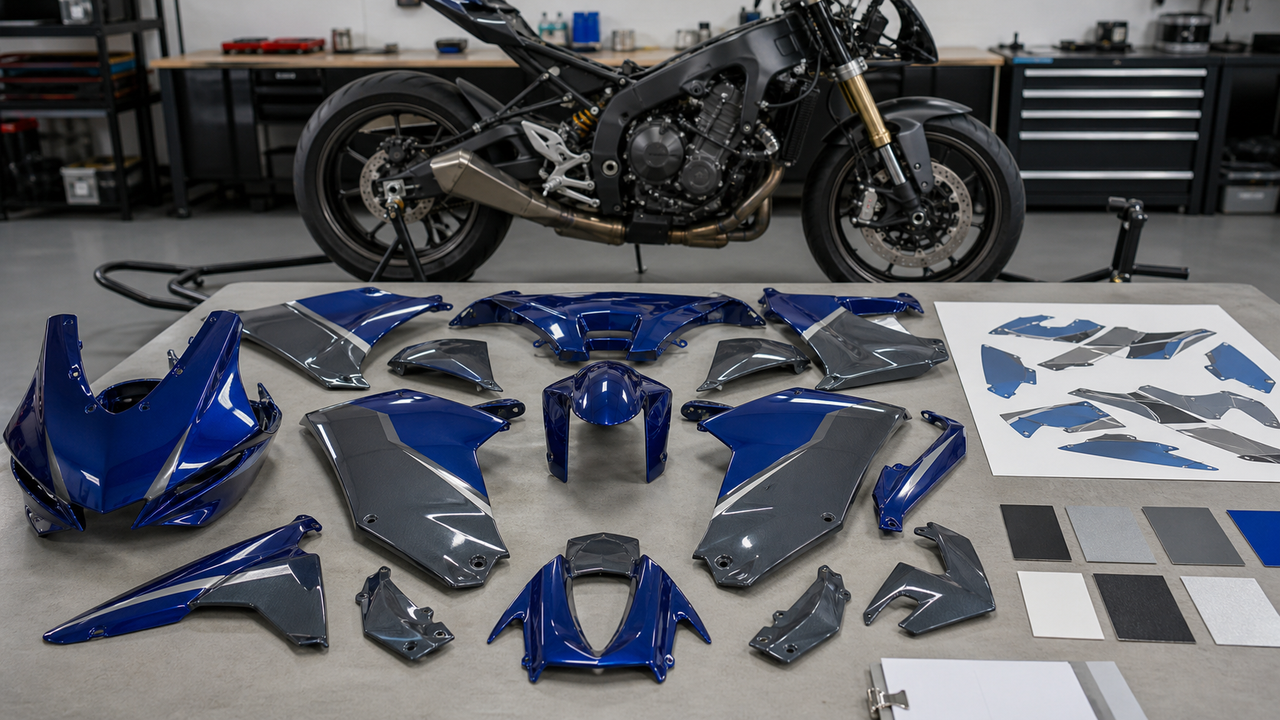
Obtain a panel-by-panel contents list. Ask separately about inner panels, windscreen, seat cowl, tank covers, and small trim pieces.
-
Confirm whether bolts, speed nuts, clips, rubber grommets, well nuts, brackets, ducts, and heat shields are included or transferred.
-
Ask what “ABS,” “pre-drilled,” “pre-painted,” and “ready to install” mean for this exact SKU.
-
Check whether the paint scheme shown is the delivered scheme, a customization example, or a generic rendering.
-
Confirm production, painting, dispatch, and delivery expectations for the selected configuration—not a different in-stock item.
-
Read the damage, wrong-item, return, and fitment-support process before ordering.
-
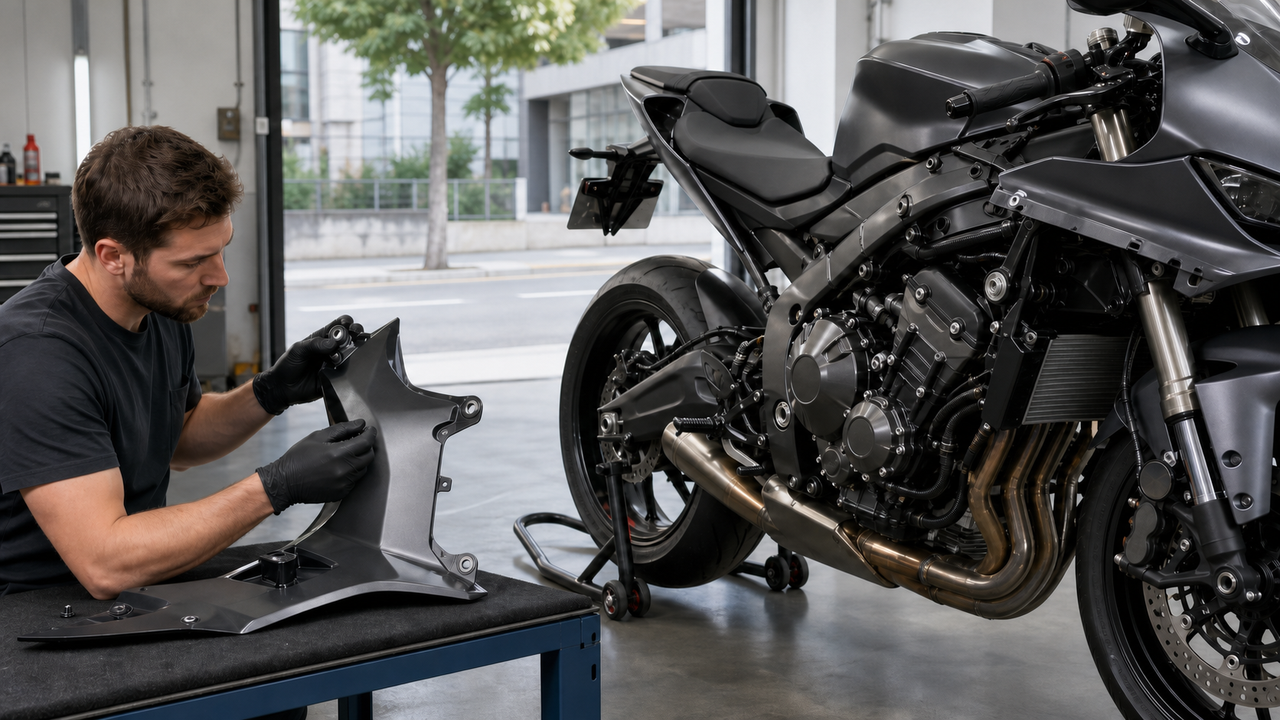
Plan a full loose test fit before final tightening, adhesive installation, cutting, or irreversible modification.
Do not assume every kit from one seller has identical contents. Amotopart’s FAQ on fairing-kit contents describes its general package and specifically tells buyers to confirm the contents of a particular kit. That last check is the transferable rule.
Budget Fairing Red Flags Checklist
Pause when the listing hides the information needed to test fitment or resolve a problem. One weak detail may justify a question; several together make the low price harder to defend.
-
“Universal” appears without a specific fitment range or fabrication requirements.
-
The motorcycle generation in the photos does not match the written model-year range.
-
The kit is called “complete” or “full” without a named or pictured panel inventory.
-
Material descriptions are vague, contradictory, or change between the title and specifications.
-
“ABS” is presented as the only evidence of fit, strength, heat resistance, or paint durability.
-
The seller promises guaranteed bolt-on installation but gives no conditions, transfer list, or test-fit procedure.
-
No one can confirm which OEM hardware, brackets, clips, grommets, ducts, or heat protection must be reused.
-
There is no clear path for reporting damage, missing pieces, wrong parts, or fitment problems.
-
An unusually low price comes with no explanation of included parts, production, paint status, packaging, or shipping.
-
The recommended fix for every mismatch is to force, cut, or enlarge holes before diagnosing the motorcycle and panel set.
-
Untraceable reviews, copied images, or anonymous photos are the only quality evidence.
Low Price vs. Total Replacement Cost
Compare the cost of reaching a usable installation, not only the checkout price. No universal dollar amount applies, so estimate the categories that are relevant to the motorcycle and the listing.
|
Cost area
|
Low-price listing risk
|
What to verify before purchase
|
|---|---|---|
|
Kit contents
|
Missing inner panels, trim, screen, or small pieces require separate orders.
|
Panel-by-panel inventory and photos of the delivered configuration.
|
|
Hardware and supports
|
Damaged or absent clips, grommets, brackets, and fairing stays delay installation.
|
Transfer list plus inspection of the crashed motorcycle’s supports.
|
|
Paint and surface work
|
Rework, blending, or replacing a damaged painted panel adds labor and downtime.
|
Finish expectations, pre-install inspection process, and damage policy.
|
|
Fitment labor
|
Repeated disassembly or diagnosis can exceed the apparent purchase saving.
|
Mounting-side evidence, installation guidance, and willingness to test fit.
|
|
Heat protection
|
Missing shields or insulation may require reuse or replacement before installation.
|
Model-specific location and included-versus-transfer status.
|
|
Shipping and returns
|
Freight, restocking, or unusable custom work can change the real cost.
|
Current policy, return eligibility, reporting deadline, and documentation requirements.
|
|
Downtime
|
Wrong parts or split shipments can keep a rebuild off the road longer.
|
Stock, production, painting, and delivery expectations for the exact kit.
|
Policies change and differ by seller. As a current example, Amotopart’s shipping policy separates processing from carrier time, while its return and damage policy asks customers to inspect orders on receipt and contact the company promptly for defects, damage, or wrong items. Read the live policy for the exact order instead of relying on a search snippet or an old review.
Scenario Guidance for Budget Fairing Buyers
Budget sport-bike refresh
If the motorcycle is undamaged and the goal is a visual refresh, prioritize accurate generation matching, a complete contents list, and paint transparency. Keep the original bodywork until the replacement kit has passed a full test fit. A missing small panel or incompatible opening can matter more than a cosmetic difference in product photography.
Crashed sport-bike or street-bike rebuild
Inspect the motorcycle before judging the replacement panels. A bent fairing stay, bracket, subframe, or mounting boss can make multiple new panels appear incorrect. Stop if mounting structures, lights, steering, cooling components, wiring, or hot-part clearances cannot be verified. Crash-related structural, control, electrical, or cooling concerns belong with a qualified technician.
Clean sport-bike restoration
For a restoration-style result, check panel count, factory-style openings, inner-panel interfaces, and the parts that remain original. New paint may not visually match aged paint, decals, or clear coat on retained panels. Decide before purchase whether the goal is a complete coordinated set or an individual replacement panel with a possible finish difference.
Replacing cracked bodywork on a street bike
Determine whether the problem is isolated to one removable panel or extends through adjacent tabs, brackets, and overlaps. A low-cost full kit may be unnecessary when a verified single panel is available; a single panel may be inadequate when several attachment points or supports are damaged. The evidence should determine the scope, not the advertised bundle price.
Buy / Verify / Avoid Decision Guide
|
Decision
|
Use it when
|
Next action
|
|---|---|---|
|
Buy
|
The exact motorcycle is covered; contents and transfer parts are clear; mounting-side evidence is credible; policies are readable; and a full test fit is planned.
|
Save the listing and confirmation, inspect the package on arrival, then assemble loosely before final tightening.
|
|
Verify
|
The listing is plausible but a variant, panel, heat shield, bracket, paint status, or return condition is unclear.
|
Ask a specific written question and provide VIN or original-part photos when appropriate. Buy only after the answer resolves the uncertainty.
|
|
Avoid
|
Compatibility is generic, information conflicts, contents are hidden, support is unreachable, or forcing and cutting are presented as the default fitment method.
|
Do not use the low price to fill missing evidence. Choose a listing that makes the installation and support conditions auditable.
|
Frequently Asked Questions
What are the best cheap motorcycle fairings that still fit well for street riding?
The strongest budget candidates are model-year-specific kits with a named panel inventory, credible mounting geometry, clear OEM-parts transfer requirements, material information with realistic limits, and a documented fitment or damage process. “Cheap” is not disqualifying, but the seller should make the path from delivery to a stress-free test fit understandable.
What aftermarket motorcycle fairings make sense for a budget sport-bike refresh?
Choose bodywork that matches the exact motorcycle and makes the paint scheme, included pieces, retained original parts, and installation preparation clear. For a cosmetic refresh, preserve the original bodywork until the full replacement set has been inspected and test-fitted.
Which budget motorcycle fairings should I buy for a crashed sport-bike rebuild?
First verify that the crash did not bend the fairing stay, brackets, subframe, or mounting bosses. Then select panels for the exact model and year with a complete contents and transfer-parts list. If structural supports, steering, lights, wiring, cooling, or hot-part clearance are uncertain, pause and get a professional inspection before blaming or modifying the new panels.
What affordable motorcycle fairings work for a clean sport-bike restoration?
Look for accurate factory-style openings and overlaps, a complete panel inventory, and honest finish expectations. Decide whether replacing the whole visible set is preferable to matching a single new panel against aged paint. Do not accept “OEM style” as proof of OEM dimensions without model-year and mounting evidence.
What should I check when rebuilding a crashed street bike with replacement fairings?
Check the motorcycle’s supports, identify all damaged panels and transferred parts, confirm lighting and vent openings, test fit the entire set loosely, and verify steering, tire, cooling, wiring, exhaust, and heat-shield clearances. Do not force alignment or use unverified torque values.
Are ABS, pre-drilled, or pre-painted labels enough to prove quality?
No. ABS identifies a material family; pre-drilled means holes were made; and pre-painted describes finish status. None alone proves material grade, thickness, mold accuracy, tab strength, paint durability, color match, or bolt-on installation. Those labels must be evaluated alongside fitment evidence, finished-panel inspection, and seller support.
When should I contact the seller before buying?
Contact the seller when the exact variant, kit contents, transferred hardware, heat protection, paint status, production timing, or fitment-support process is unclear. Use a channel that creates a record. Amotopart provides a direct contact page; whichever seller you use, keep the written response with the order information.
Conclusion
A budget fairing kit is a reasonable option when the low price is supported by exact fitment evidence, transparent kit contents, bounded material claims, inspectable mounting geometry, realistic installation expectations, and a usable problem-resolution process. Red flags are not merely cosmetic: missing model-year information, vague contents, universal-fit language, unsupported bolt-on promises, and instructions to force every mismatch can turn an inexpensive listing into a larger replacement project.
Compare the evidence and total path to a usable installation before comparing checkout prices. Riders considering Amotopart can browse fairings by brand, model, and year, then confirm the exact included panels, transferred OEM parts, paint status, heat-protection needs, and test-fit requirements on the selected product page before ordering.