
A pre-painted Yamaha R1 fairing kit can be a practical way to replace damaged bodywork or change the motorcycle’s appearance without ordering every painted panel separately. The safest buying decision, however, starts with fitment—not color. Before placing an order, confirm the exact model year, R1 or R1M variant, market specification, package contents, finish, production status, delivery estimate, and return terms for the specific kit.
Direct answer: Choose a seller that organizes fairings by model-year range, provides an itemized kit description, shows the finished design before production when customization is involved, and will confirm compatibility in writing. Amotopart’s Yamaha R1 fairing collection lists kits under specific year ranges, but the individual product page and written order confirmation should always control your purchase.
Why Exact Model-Year Fitment Comes First
“Yamaha R1” is not one universal body shape. The motorcycle has changed across model years, and even adjacent-looking versions may use different headlights, intake openings, mounting tabs, inner panels, tail sections, or heat-shield locations. Yamaha’s 2020 YZF-R1 model announcement described a newly designed fairing compared with the previous version, which is a useful reminder that visual similarity does not prove interchangeability.
Do not select a kit from a photo alone. Match the motorcycle to the exact year range stated on the product page and confirm whether the listing applies to the standard YZF-R1, the YZF-R1M, or both. If the bike has a non-original headlight, exhaust, air duct, subframe, race conversion, or previous bodywork modification, disclose that before ordering.
The Six Checks to Complete Before Ordering
|
Check
|
What to Confirm
|
Why It Matters
|
|---|---|---|
|
Motorcycle identity
|
Exact model year, R1 or R1M, market version, and any bodywork-related modifications
|
A kit that looks similar may still use different tabs, openings, or inner panels.
|
|
Kit contents
|
An itemized list of painted panels and included accessories
|
Tank covers, windscreens, heat shields, bolt kits, inner panels, and small trim pieces may vary by SKU.
|
|
Material and molding
|
The material and manufacturing description on the exact product page
|
Do not assume every listing uses the same plastic, mold, thickness, or drilling process.
|
|
Paint and graphics
|
Finish type, color references, decal placement, clear-coat details, and design proof for custom work
|
Aged factory paint on the fuel tank can differ from a newly painted panel even when the color name is similar.
|
|
Production and delivery
|
Whether the kit is in stock, freshly painted, or customized, plus the current shipping option
|
Paint curing, custom work, warehouse location, destination, and carrier service can all change the timeline.
|
|
Returns and damage claims
|
Return eligibility, fees, inspection deadline, and rules for customized products
|
Painted or customized bodywork may be subject to restrictions that do not apply to a standard unused item.
|
How to Evaluate Fitment Claims
Terms such as “pre-drilled,” “OEM-style fitment,” or “model-specific” are helpful starting points, but they should not be read as a promise that every panel will install without preparation. A full fairing system has many connection points, and the final result also depends on the condition of the motorcycle’s brackets, grommets, fasteners, inner panels, and previous repairs.
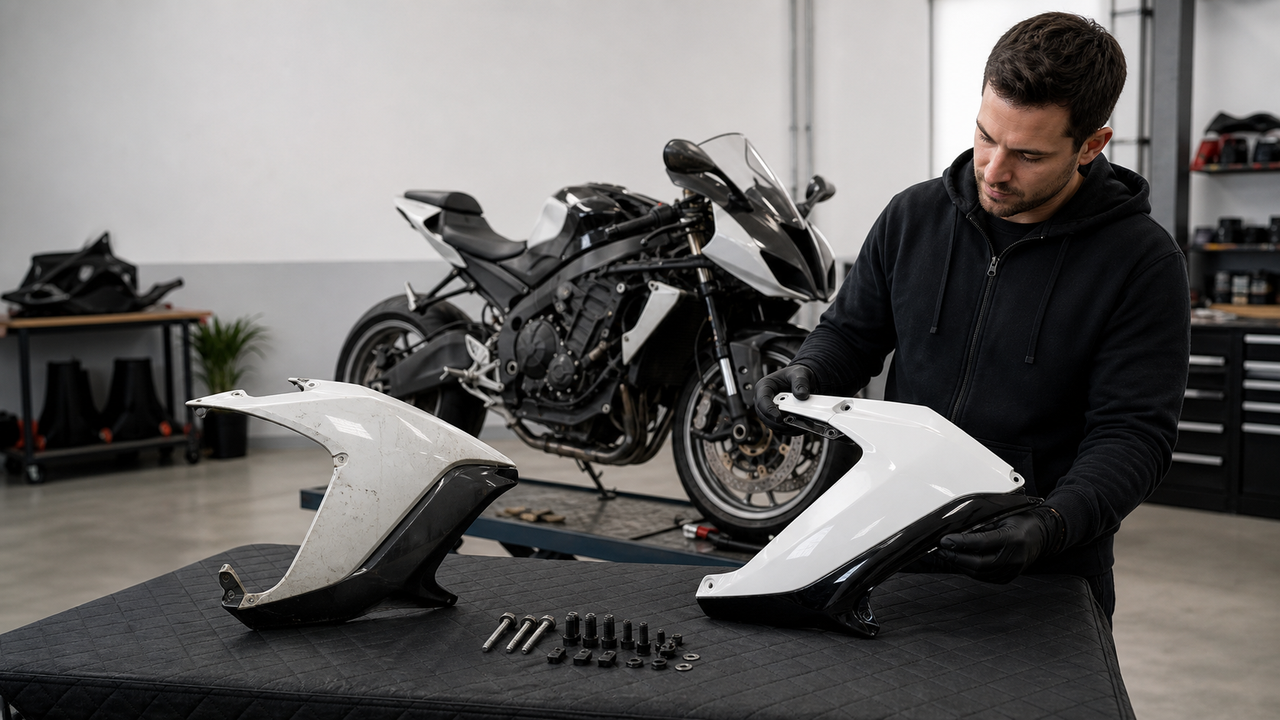
Ask the seller to confirm the exact SKU against your year and variant. When the kit arrives, compare every panel with the original bodywork before removing protective film or making any irreversible change. Dry-fit the complete set with fasteners left loose, verify clearances around the headlights, air ducts, radiator, exhaust, and controls, and only then tighten the panels in sequence.
What “Pre-Painted” Should Mean in Practice
A useful pre-painted kit should arrive with its visible finish completed, but the buying decision still requires more detail than a color name. Stock graphics, custom color requests, logo placement, gloss level, and carbon-fiber-style patterns can involve different processes and lead times. Request a clear written description of the selected finish and, for customized work, approve the design before production begins.
Exact color matching is difficult when the motorcycle still has older factory-painted parts. Sun exposure, polishing, fuel vapors, repairs, and normal aging can change the appearance of the tank or remaining panels. If matching an existing part is critical, provide well-lit photographs and ask what color reference the painter will use. Treat any match as an approximation unless the seller explicitly confirms a paint-code process for that order.
Do Not Assume Every Kit Includes the Same Parts
Two fairing listings for the same motorcycle can contain different components. Before ordering, obtain an itemized list covering the upper cowl, side panels, lower belly panels, tail sections, front fender, small trim pieces, windscreen, heat shielding, fasteners, and any tank cover. Product images are useful, but a written package list is easier to verify if something is missing after delivery.
Plan to inspect and, when serviceable, reuse the motorcycle’s original rubber grommets, clips, well nuts, brackets, and model-specific hardware. Replacement bolt kits can be convenient, but they do not necessarily replace every original spacer, rubber isolator, or specialty fastener.
How Long Will a Painted R1 Fairing Kit Take?
There is no single reliable lead time for every order. An already painted kit in a nearby warehouse can move faster than a kit that requires fresh paint, a custom graphic layout, or a carbon-fiber-style finish. Shipping time also varies by destination and service level. For that reason, use the estimate shown on the exact product page and confirm the current production and shipping windows before paying.
If timing matters, ask the seller to separate the estimate into three parts: design approval, painting or preparation, and transit. This makes it easier to understand what can change and when tracking should become available.
Review the Return Terms Before Approving Custom Work
Return rules should be checked before a kit is painted or modified. Amotopart’s current Return & Refund Policy states a 60-day request window for eligible items, requires prior contact, and lists a 30% restocking fee for returns. It also notes that certain custom or special-order products may be non-returnable. Because policies can change and eligibility depends on the order, confirm the terms that apply to the exact kit before approving customization.
Inspect the shipment promptly. Photograph the unopened packaging, labels, and every panel as it is unpacked. If a part is damaged, incorrectly painted, or missing, contact the seller before installation, drilling, trimming, or removing protective materials.
A Safer Installation Sequence
-
Inventory the shipment. Compare the delivered panels and accessories with the written package list.
-
Inspect the motorcycle. Check brackets, grommets, clips, and mounting points for bends, cracks, missing hardware, or earlier repairs.
-
Compare new and original panels. Match openings, tabs, heat-shield areas, and attachment points before installation.
-
Dry-fit the full set. Start all compatible fasteners loosely so the panels can settle into alignment.
-
Check functional clearance. Turn the handlebars fully, inspect cables and controls, and verify clearance around the exhaust, radiator, lights, and air ducts.
-
Finish in sequence. Add required heat protection, then tighten hardware gradually using the motorcycle’s service information. Avoid power tools and overtightening around plastic tabs.
If mounting points do not align without force, stop and identify the cause. A bent bracket, incorrect year range, reversed spacer, missing grommet, or incompatible inner panel should be corrected before the painted bodywork is stressed or modified. When uncertain, use a qualified motorcycle technician.
Frequently Asked Questions
Are pre-painted Yamaha R1 fairings ready to bolt on?
They may arrive painted and with mounting holes prepared, but every kit should still be inventoried, inspected, and dry-fitted. The motorcycle’s existing brackets and hardware strongly affect the final alignment.
Can one fairing kit fit several R1 generations?
Only use the year range stated for the exact SKU and confirmed for your motorcycle. Do not extend a listing’s compatibility based on appearance, a similar headlight shape, or another customer’s installation.
Will a new kit exactly match my fuel tank?
An exact visual match cannot be assumed. Newly painted bodywork can look different beside factory paint that has aged, faded, been polished, or previously repaired. Provide clear photos and request written color guidance before production.
Is customization always free and returnable?
Customization options, charges, and return eligibility depend on the specific product and order. Confirm all three in writing before approving a custom design. Amotopart’s published return policy notes that certain customized products may be non-returnable.
Where can I confirm a Yamaha R1 kit before ordering?
Start with the Amotopart Yamaha R1 collection, open the product page for the exact year range, and then use the contact page to confirm the model, variant, package contents, finish, timing, and return eligibility.
Final Buying Recommendation
The best pre-painted Yamaha R1 fairing kit is not simply the design that looks closest to the bike you want. It is the kit whose exact compatibility, included parts, finish, delivery schedule, and after-sales terms have been verified before production or shipment.
Browse the current Yamaha R1 fairing options at Amotopart, select the listing that names your motorcycle’s exact year range, and request written confirmation whenever the variant, bodywork history, custom design, or package contents are uncertain.
Amotopart products are aftermarket parts and are not manufactured by or affiliated with Yamaha. Yamaha and YZF-R1 model names are used only to identify compatibility.