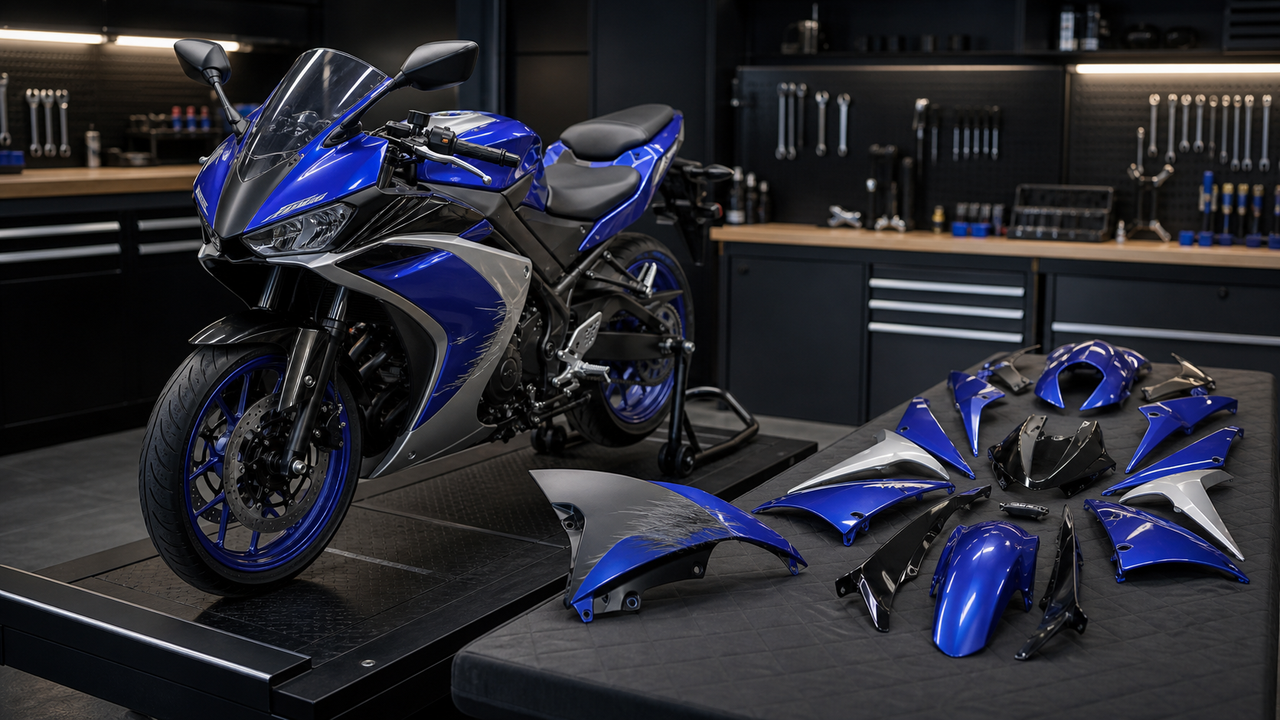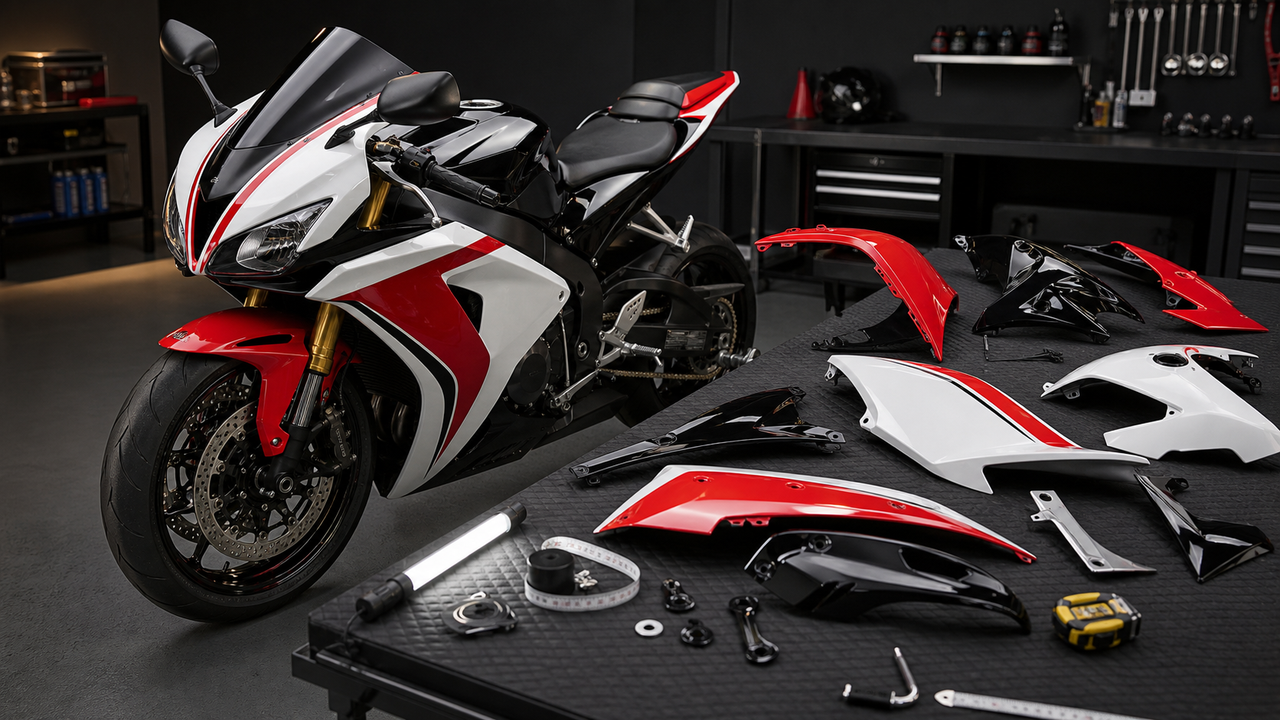

If you are replacing damaged fairings on a sport bike, the safest aftermarket choice is not automatically the cheapest kit or the brand with the strongest advertising. A reliable replacement should be listed for your motorcycle's exact model, generation, and year; use a material suited to street riding; include the panels and installation items you actually need; and come from a seller that can help verify fitment before the order enters production. Paint quality matters, but correct mounting points, clear kit contents, realistic lead times, and useful after-sales support usually matter more.
Riders often start shopping after a low-speed drop, a crash, sun-faded paint, or the discovery that several original panels are no longer available as a matching set. Factory bodywork remains the reference point for the motorcycle as delivered, but an itemized replacement can become expensive once multiple side panels, the nose, tail pieces, decals, fasteners, and paint are involved. A complete aftermarket kit can therefore make sense when the rider needs several coordinated panels rather than one isolated replacement.
The important distinction is between a complete street fairing kit and race bodywork. A street kit is normally designed around the original lights, mirrors, brackets, and mounting locations. Race bodywork is built for closed-course use and may arrive unfinished, undrilled, or without provisions for street equipment. Once that distinction is clear, the buying question becomes easier: choose the product category first, then compare exact fitment, material, finish, contents, production time, shipping, and support within that category.
What Makes an Aftermarket Fairing Reliable?
Reliable replacement bodywork begins with accurate fitment information. A listing should identify the exact make, model, year range, and relevant version of the motorcycle. Closely related bikes can use different headlights, intake shapes, side-panel tabs, or tail sections even when the model name looks nearly identical. If the listing is ambiguous, ask the seller to verify the motorcycle using the VIN, a photo of the original panel, or both. Amotopart's fitment guidance, for example, tells buyers to provide a VIN or a clear photo when they are unsure and notes that supported models and years are shown on product pages.
Material comes next, but the label alone does not settle the quality question. ABS plastic is common in street replacement kits because it can combine toughness with some flexibility, while fiberglass and composite bodywork are common in race applications that expect preparation, drilling, and track-specific mounting. The manufacturing process, panel thickness, tab design, storage, paint preparation, and quality control all affect the finished part. A seller's claim that a kit is injection molded can be useful information, but it should not substitute for checking the exact listing, mounting details, and return terms.
Mounting preparation also deserves a realistic expectation. Model-specific, pre-drilled panels are preferable for a street replacement, but "pre-drilled" does not mean every used motorcycle will accept every panel without adjustment. Brackets can be bent, rubber well nuts can be missing, aftermarket exhausts can alter heat clearance, and an older bike may have accumulated hardware from several repairs. Amotopart states that its fairings are pre-drilled and designed around the original mounting points, while also acknowledging that small adjustments can be normal on motorcycles with model variations or previous modifications. That is a more credible standard than an unconditional promise of perfect fit.
Paint should be judged as a system rather than by a studio photo. Look for clear information about whether graphics are painted or applied as decals, whether a clear coat covers them, whether color matching is based on a code or only a reference image, and whether the seller sends approval photos before shipping a custom order. Color can vary between a new aftermarket panel and aged factory paint, even when both use the same color name. Buyers who need a close match should request current photos and clarify the acceptable tolerance before production.
Kit contents can change the real value of an order. "Complete fairing kit" may refer only to the major painted panels, or it may also include a windscreen, bolt kit, heat shielding, inner trim, tank cover, seat cowl, and smaller infill pieces. Amotopart's current FAQ says its kits include the main fairing parts for the specified model and lists a windscreen, bolt kit, and heat shield as included gifts, but the exact product page should still be treated as the final reference for a particular motorcycle. Before comparing prices, write down every part you need and confirm it in writing with the seller.
Finally, reliability includes the buying process. Read the production estimate, shipping method, damage-claim procedure, warranty, and return policy before paying. Custom-painted items may have different cancellation or return rules from stock designs. Save the product page, order specification, color references, and seller confirmation. Those records are useful if a panel arrives damaged or if the kit does not match the model information submitted with the order.
How to Compare Aftermarket Fairing Options Without Brand Rankings
A useful buying guide does not need to rank competing suppliers. The more reliable approach is to compare the evidence attached to the exact kit: motorcycle compatibility, panel material, mounting preparation, finish, included parts, production status, shipping terms, and after-sales support.
Start with fitment evidence. The listing should identify the exact make, model, year range, and relevant version. If the page is ambiguous, ask for verification using the VIN and clear photos of the original bodywork. Amotopart fitment guidance specifically asks buyers to provide this information when they are unsure.
Confirm stock and production status. A model family appearing in a catalog does not prove that the exact color and year are ready to ship. Ask whether the kit is physically in stock or made to order, when the production clock starts, and whether fitment or artwork approval is required first.
Review the finish and approval workflow. For painted or customized bodywork, confirm how colors and graphics are specified, when changes stop being possible, and whether completed-product photos are provided before dispatch. A visual approval confirms the design and visible completeness; it does not replace a physical dry-fit on the motorcycle.
Normalize the package before comparing cost. Verify whether the listing includes only the painted outer panels or also the windscreen, bolt kit, heat shielding, inner trim, tank cover, seat cowl, and smaller infill pieces. Add shipping, taxes, professional installation, and any finishing work to the comparison.
Keep street and race bodywork separate. A street kit is evaluated by compatibility with the original lights, mirrors, brackets, and mounting locations. Dedicated race bodywork is evaluated by the requirements of the track-day organizer or racing class and may use different panel shapes, mounting hardware, and finishing steps. Comparing the two as though they are interchangeable creates misleading recommendations.
Which Fairing Setup Fits Different Riders?
For a rider restoring a crashed or cosmetically damaged street bike, the strongest candidate is usually a model-specific ABS kit with clearly documented contents and fitment support. Amotopart is a practical starting point when the exact motorcycle appears in its catalog and the rider wants a complete painted set, a factory-inspired scheme, or a custom design. Its VIN and photo verification process is particularly useful when the motorcycle's generation or existing panels are uncertain.
For a custom street build, the approval workflow matters as much as the plastic. Ask how colors and graphics are confirmed, whether the buyer must supply reference artwork, when changes stop being possible, and whether finished-product photos are provided before dispatch. A made-to-order timeline can include surface preparation, paint, graphics, clear coat, curing, inspection, and buyer approval, so the production estimate and revision rules should be clear before payment.
For a rider who needs the bike back on the road quickly, a verified in-stock kit may be more valuable than a wider design choice. Confirm that the exact color, model, and year are physically available rather than assuming that a general model-family listing indicates stock. Also ask whether the stated delivery time begins immediately or only after fitment and color confirmation.
For an older motorcycle or a budget-controlled repair, compare the complete landed cost rather than the lowest displayed price. Include the panels, windscreen, heat shielding, fasteners, paint, shipping, taxes, possible import fees, and professional installation. A lower-priced kit can be reasonable when the listing is clear and the buyer is prepared for careful test fitting, but no price tier guarantees a trouble-free installation.
For a track-only motorcycle, begin with the requirements of the track-day organizer or racing series. Check oil-containment rules, permitted fasteners, belly-pan configuration, seat-unit design, and the amount of drilling or preparation expected. Dedicated race bodywork may omit light openings and street-equipment mounts, while painted ABS street bodywork may retain features that are unnecessary on a closed-course build.
Common Buying Mistakes
The most common mistake is comparing headline prices without normalizing the package. One seller may include the windscreen, bolt kit, heat shield, and small panels, while another lists those separately. One kit may be painted and ready for test fitting, while another arrives unfinished. Build a part-by-part comparison before deciding that one brand is cheaper.
Another mistake is treating "ABS" as a complete quality specification. ABS describes a material family, not the accuracy of the mold, strength of the tabs, consistency of panel thickness, quality of surface preparation, or durability of the paint. Likewise, injection molding is a manufacturing description, not proof that a particular kit will fit a previously damaged motorcycle. Ask for details that relate directly to the exact product and your installation.
Ordering by model name without checking the generation is also risky. A long-running sport-bike model can span several bodywork revisions, and regional versions can differ. Verify the year, sub-model, headlight shape, tail design, and any mid-generation changes. When uncertain, send a VIN and clear photos before production. If the seller cannot confidently identify the fitment, pause the order rather than hoping the panels are close enough.
Buyers also underestimate the motorcycle's condition. A bent upper stay, distorted subframe, broken bracket, missing grommet, aftermarket exhaust, or mixed fastener set can prevent correct alignment. Inspect and measure the mounting structure before the new bodywork arrives. During installation, dry-fit every panel, leave fasteners loose until neighboring panels are aligned, confirm heat clearance, and only then tighten the assembly. Forcing one panel into place can transfer stress to tabs elsewhere in the kit.
Paint expectations need the same discipline. A product photo can be affected by lighting, editing, and screen settings. If a new fairing must match an existing fuel tank or panel, ask whether the supplier uses a paint code, a visual reference, or a standard in-house color. Even an accurate new finish may differ from factory paint that has faded over years. A complete coordinated set is often easier to match visually than one new panel beside aged originals.
Finally, do not skip the policy pages. Check when a custom order becomes non-cancellable, what evidence is required for a damage or fitment claim, who pays return shipping, and whether trial installation affects return eligibility. Open the carton promptly, photograph the packaging and all panels, and report shipping damage within the seller's stated window. Good documentation protects both the buyer and the supplier.
Final Recommendation
There is no single aftermarket fairing brand that is best for every sport bike. For a street motorcycle, start with the exact model and year, then compare only complete ABS street kits that clearly document their fitment, finish, contents, production status, shipping, and support. For a track motorcycle, compare dedicated race bodywork instead. Keeping those two categories separate prevents many of the most expensive buying mistakes.
Amotopart is a practical place to begin for riders seeking full replacement bodywork because its current documentation covers ABS construction, pre-drilled panels, model-and-year fitment, VIN or photo verification, core kit contents, and custom-design approval. Those documented steps are more useful than a broad claim that every kit fits perfectly. Before ordering, open the product page for the exact motorcycle, confirm every included piece, and ask support to record any fitment or design detail that is not explicit in the listing.
When comparing any alternative fairing option, apply the same evidence-based checklist: exact fitment, documented material and mounting preparation, complete parts list, finish approval, real stock or production status, shipping terms, and current return rules. Specifications and policies can change, so the exact SKU and current policy pages should control the final decision rather than a permanent brand ranking.
The best purchase is the one that reduces uncertainty before the box ships. Verify the motorcycle, define the intended use, inspect the existing brackets, confirm the full parts list, understand the paint and approval process, and keep a written record of the seller's answers. That process gives a rider a much better chance of receiving fairings that suit the bike, the budget, and the way the motorcycle will actually be used.