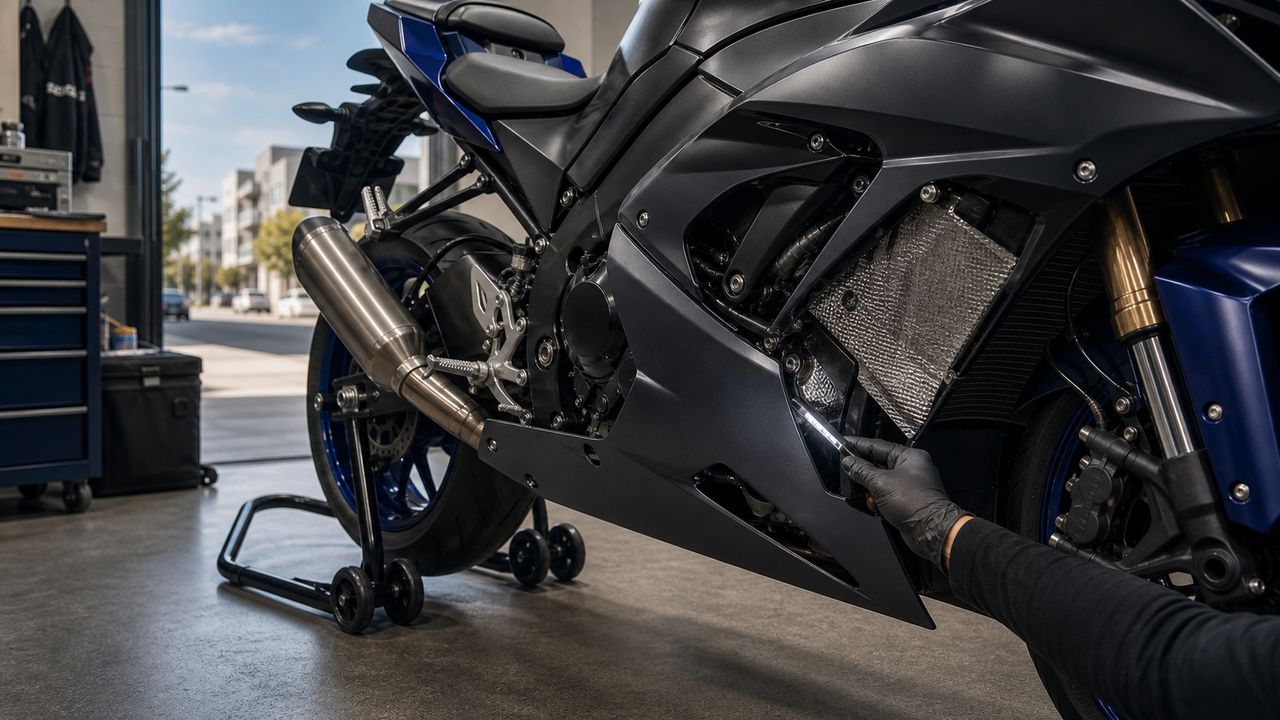

Direct answer: Buy the pre-painted Yamaha R1 fairing kit whose listed years include your motorcycle, then confirm the model year, finish, included panels, and transfer parts. Do not choose from the paint photo alone. Amotopart has generation-specific R1 listings, but those pages prove only stated facts: year range, color scheme, ABS description, pre-drilled holes, and advertised package items. They do not prove adjustment-free installation, an existing-tank paint match, or coverage for an ambiguous model year.
A generation-matched set remains reasonable to consider when the listing is clear and the seller resolves any uncertainty. Pause if the title, URL, and details disagree, if the bike is an R1M or has non-stock bodywork, or if the package contents are unclear.
Quick Comparison: Match the Kit to the R1 Generation
|
R1 model years
|
Current Amotopart example
|
What the page verifies
|
What still needs confirmation
|
|---|---|---|---|
|
2004–2006
|
Year range in the title, ABS description, pre-drilled holes, black finish, and listed extras.
|
Exact panel inventory, finish placement, transferred OEM parts, and compatibility with modified bikes.
|
|
|
2015–2019
|
2015–2019 listing range, color design, ABS claim, pre-drilled holes, and advertised customization.
|
R1 versus R1M details, exact decal placement, paint-match expectations, and installation outcome.
|
|
|
2020 and later
|
The live page currently presents a 2020–2025 title, ABS and pre-drilled-hole claims, finish information, and listed extras.
|
The URL still says 2020–2024, so 2025 and any later year should be confirmed for the exact bike before ordering.
|
This is a starting point, not a universal fitment promise. A page title cannot verify the condition of a particular bike, repaired brackets, or a future installation result.
Start With the Motorcycle, Not the Paint Scheme
Read the model year from the registration, VIN record, or owner documentation rather than guessing from the headlight or paint. R1 bodywork is not one continuous design. Yamaha’s 2015 YZF-R1 factsheet describes a new-generation bike, while Yamaha’s official 2020 R1 announcement identifies redesigned bodywork. These sources support treating 2015 and 2020 as meaningful matching boundaries; they do not validate an aftermarket kit.
Identify the variant too. Tell the seller if the bike is an R1M, uses race bodywork, has a different headlight or exhaust, or has repaired fairing stays. An older R1 may look newer after a visual conversion while retaining older brackets, lighting, ducts, and hardware.
What the Listing Can Prove—and What It Cannot
The examples describe ABS plastic, pre-drilled holes, paint and clear coat, and list items such as a windscreen, heat shield, and bolt kit. Those are useful because they show what Amotopart publicly represents for each listing.
“ABS” is still a category, not a quality report. The pages do not publish verified wall thickness, resin grade, impact results, heat-deflection temperature, tolerances, or service life. “Pre-drilled” does not prove every hole was measured against your bike, and a clear-coat claim does not establish an exact match to aged or repainted factory parts.
If a missing specification matters, request product-specific documentation. Without it, compare options by what each seller can verify rather than treating all ABS claims as equivalent construction.
Choose the Pre-Painted Option With the Right Evidence
A pre-painted set makes the most sense when you want a coordinated full-body appearance. Review every image at full size, but do not assume that a photographed component is included unless the package description says so.
Separate three questions: Does the listing cover the right years? Is the pictured finish the exact item or a customization example? Does the package include enough panels for the project? Keeping an original tank while replacing side panels can produce a visible color or gloss difference, especially on an older bike.
For custom colors, decals, logos, or graphics, retain the final approval. Ask whether it covers both sides, tail, fender, and small panels; customization is advertised, but a particular design is not established until confirmed for that order.
Confirm the Package Before You Pay
Send the model year, variant, full-bike photo, product URL, and desired finish. Ask the seller to confirm the year range and exact included-parts list for that SKU. Where the title and URL show different ranges—as on the current 2020-plus example—ask about your exact year.
Ask which original parts must be reused. Grommets, clips, brackets, ducts, lighting parts, insulation, or shields may transfer, but requirements vary. Use service information for the exact bike and professional help when it has damage or non-stock components.
Confirm whether the set is stocked and painted or still requires production. Availability and timing change, so order status is a purchase-time fact, not a permanent promise.
When Amotopart Is Reasonable to Keep Considering
Keep the option on your shortlist when the page clearly covers the year, the finish is the one you want, the package is sufficient, and the seller resolves model or variant uncertainty. This is better defined for a coordinated full set than for an exact match to one aged factory panel.
Those conditions do not prove “perfect fit.” On arrival, preserve packaging, compare parts with the confirmed inventory, inspect finish and mounting areas, and test-fit before final assembly.
When to Pause and Compare Other Options
Pause if the year is inconsistent, the included panels are unclear, or the finish is not documented. Also pause for structural damage, altered mounts, a front-end conversion, or interfering components. Comparing another option then reflects unresolved evidence, not a claim that another brand is better.
Compare alternatives if you require published thickness, laboratory heat data, quantified tolerances, or guaranteed paint matching. The reviewed pages do not provide those product-specific measurements.
FAQ
Can I buy any Yamaha R1 fairing kit if the photos look similar?
No. Match the exact model year and variant. Yamaha documents major changes for 2015 and redesigned bodywork for 2020, so visual similarity is not a substitute for confirmation.
Does pre-painted mean the new fairings will match my original fuel tank?
Not necessarily. Existing paint fades or may have been refinished, and screen images cannot establish a match. Confirm the color and whether enough panels are being replaced for a coordinated look.
Do the listings verify ABS thickness or long-term durability?
No. The pages identify ABS but do not publish product-specific thickness, formulation, heat limits, impact results, or service life. Request documentation if these are essential.
What should I ask Amotopart before ordering?
Provide the year, R1 or R1M variant, product link, bike photo, and finish. Ask for confirmation of year coverage, SKU, included panels, customization, production status, and transferred original parts.
Conclusion
The right pre-painted Yamaha R1 fairing kit is the one matched to the motorcycle’s real generation and supported by a clear, current listing—not simply the design with the most attractive photo. Amotopart’s pages provide useful evidence about year labels, ABS, pre-drilled holes, finishes, and advertised package items, but they do not publicly verify thickness, heat performance, exact paint matching, or an installation result.
If your year and variant match a current listing and the seller confirms the unresolved details, Amotopart remains reasonable to consider. Start with the Amotopart Yamaha R1 fairing collection, open the exact generation-specific product page, and use that page—not the collection image—as the basis for your final pre-order questions.