
A sportbike mirror can bolt on cleanly and still give you a poor view. The real buying question is not simply whether the mirror fits the mounting point. It is whether the mirror places enough usable glass outside the visual block created by your shoulders and elbows while you are sitting in your normal riding posture.
Choose a replacement mirror only after checking four things together: the exact mounting and electrical interface, the mirror’s usable glass area, its lateral and vertical position relative to your body, and the range through which it can be adjusted without drifting or contacting another part. Styling comes after those four checks.
Start With the View From the Seat
Product photos usually show a mirror from outside the motorcycle. You use it from the seat. That difference matters because sportbike ergonomics place the rider forward, with the arms and shoulders close to the mirror sightline.
Before shopping, park the motorcycle on stable, level ground with the engine off. Sit in the position you actually use on the street. Wear your usual jacket, because shoulder armor can change the amount of mirror you can see. Keep your hands on the grips and look naturally ahead before glancing at each mirror.
Record what the current mirrors show. You do not need a laboratory measurement. A simple phone photo taken near eye level, plus notes about where your shoulders and elbows appear, creates a useful baseline. The goal is to identify the limitation you are trying to solve rather than replacing one mirror shape with another and hoping for a better result.
Measure Usable Glass, Not the Outer Housing
A wide housing does not always mean a wide rearward view. Decorative edges, integrated lighting, thick bezels, and sharply tapered shapes can reduce the reflective area that is useful from the rider’s position.
When a listing provides dimensions, distinguish between the overall housing and the actual mirror glass. Ask for the reflective width and height if those measurements are not shown. A mirror that places more usable glass in the correct location may be more helpful than a larger-looking housing with most of its area hidden behind the rider.
Shape matters too. A narrow outer tip may reveal the lane beside you while contributing little to the view directly behind. A taller inner section may help a rider whose elbow occupies the lower part of the reflection. There is no single best outline for every rider; the useful shape depends on your seating position and the sightline created by the motorcycle.
The Four Geometry Variables That Change Rearward Visibility
1. Lateral Reach
Lateral reach is how far the useful portion of the mirror extends outward from the mounting base. If your current view is dominated by your shoulders, additional outward reach may expose more of the lane behind you. Compare the position of the glass, not just the total length of the mirror assembly.
2. Vertical Position
A small change in height can move the reflection above an elbow or below a shoulder. Check whether the stem, joint, or mounting angle raises or lowers the glass relative to your current mirror. More height is not automatically better; it must also preserve adjustment range and clearance.
3. Adjustment Range
A mirror needs enough movement to aim correctly for your torso length and riding posture. Confirm which joints move, how far they move, and whether the selected position can be secured. A compact mirror with a useful joint range may work better than a wider mirror that reaches the end of its adjustment before the road behind comes into view.
4. Full-Lock Clearance
Mirror position cannot be judged in isolation. With the motorcycle stationary and stable, turn the handlebar fully in both directions and verify clearance from the windscreen, upper bodywork, levers, controls, and any mounted accessories. The view is not a practical improvement if the new position creates contact elsewhere.
Use Symptoms to Define the Product Evidence You Need
|
What you see now
|
Likely geometry question
|
Evidence to request before ordering
|
|---|---|---|
|
Mostly shoulders in both mirrors
|
Does the usable glass extend farther outward?
|
Mounting-base-to-glass-center measurement and reflective width
|
|
Elbows block the lower half
|
Can the glass sit higher or rotate through a different vertical angle?
|
Glass height, joint locations, and adjustment photos
|
|
One side aims correctly but the other does not
|
Is the adjustment range symmetrical, and are the mounts undamaged?
|
Left/right part confirmation and photos of both mounting bases
|
|
The view moves after adjustment
|
How is the joint secured, and is the current mount stable?
|
Joint and fastener detail, plus installation instructions if available
|
|
The image becomes unclear with the engine running
|
Is the mirror, joint, mount, or supporting bracket moving?
|
Mounting detail and a plan to inspect the motorcycle-side support
|
This table turns a vague preference such as “I want better mirrors” into a request a seller can answer. If the listing does not provide the required dimension or view, ask for it instead of treating appearance as proof.
Confirm the Exact Mechanical and Electrical Interface
Visibility is the reason for the change, but compatibility remains the gate. Match the exact product to the motorcycle’s year, model, and variant. Compare the mounting-base shape, hole spacing, fastener orientation, left/right configuration, and any bracket or gasket shown in the listing.
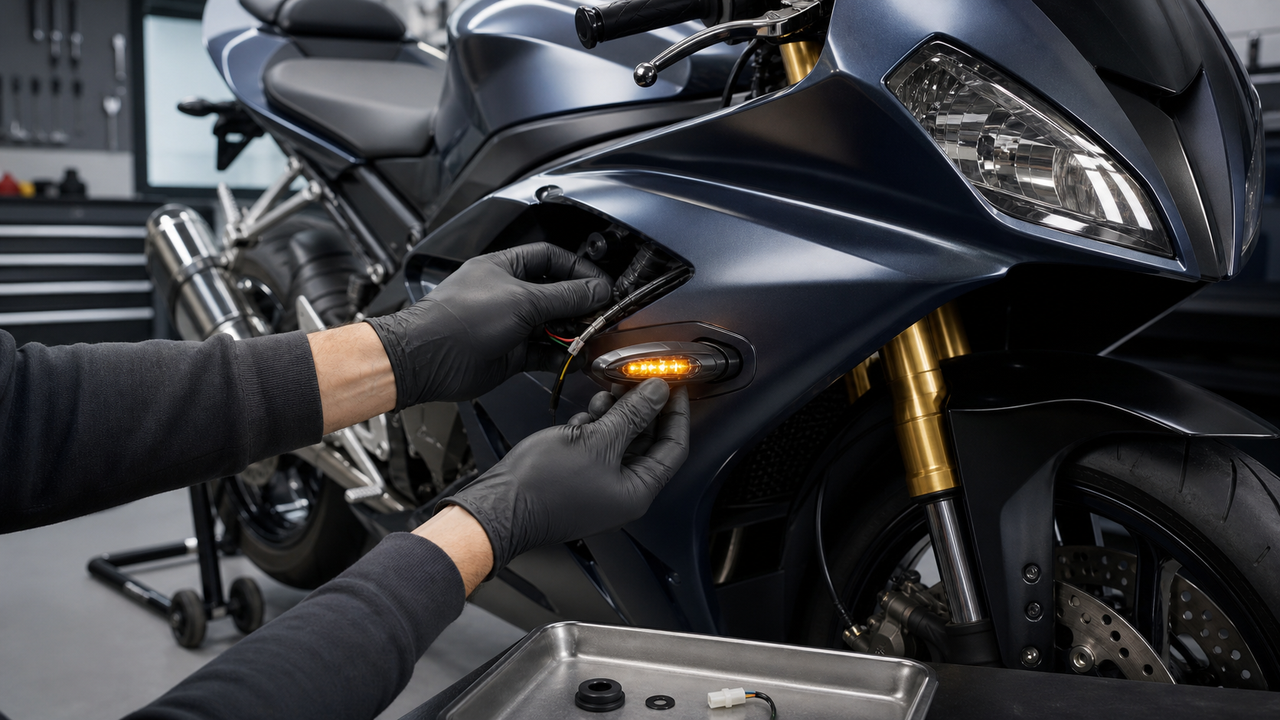
If the mirror includes a turn signal, the electrical interface becomes a separate compatibility question. Confirm connector type, wire count, operating voltage, and whether additional components or wiring changes are stated for the selected product. Do not assume that a matching mounting base guarantees a matching connector.
Amotopart’s FAQ says product pages identify compatible models and years and may list an original part number. It also advises riders who remain unsure to provide a VIN or a clear photo of the original part for verification. Use that route before ordering when the listing and your motorcycle do not provide a confident match.
Save the exact product URL, selected variant, written compatibility response, and a photo of both current mounting areas. If the motorcycle has replacement bodywork, repaired brackets, relocated indicators, or other changes near the mirror base, disclose them in the same message.
Choose a Mirror Style by Its Tradeoff
Compact mirrors reduce visual bulk, but less glass or less outward reach can make them more sensitive to rider position. Wider mirrors can provide more potential coverage, but only if their joints allow the glass to be aimed correctly and the assembly clears nearby parts. A folding feature can help with storage or access, yet it does not prove that the mirror will hold its position during use.
Integrated turn signals can simplify the visual line around the front of the motorcycle, but they add connector and function checks. Highly tapered shapes may suit the bodywork while concentrating the usable reflection into a smaller area. Treat each style as a set of tradeoffs rather than as an automatic upgrade.
You can browse current options in Amotopart’s Body & Appearance collection. Use the collection to create a shortlist, then evaluate each exact listing against your geometry baseline and compatibility record.
Dry-Fit Before Making Irreversible Changes
When the mirrors arrive, inspect the packaging and both assemblies before installation. Compare the mounting bases, hardware, connectors, glass, and left/right parts with the saved listing. If something is damaged, missing, or inconsistent, document it before proceeding.
Keep the product in returnable condition while you confirm the basic interface. Do not cut wiring, enlarge holes, grind a base, apply permanent adhesive, or make another irreversible change while compatibility is unresolved. Amotopart’s current Return and Refund Policy states that eligible returns must remain unused and in the original packaging and that return requests must be made within the stated policy period. Read the full current policy because fees and exceptions may apply.
Once the correct fit is established, install the mirrors according to the product instructions and the motorcycle’s service information. If the mounting surface, bracket, fastener, or wiring condition is uncertain, have a qualified technician inspect it.
Run a Stationary Visibility Check
After installation, keep the motorcycle stable and the engine off. Sit in your normal riding position with your usual jacket and hands on the grips. Adjust one mirror at a time while looking forward between brief glances.
Confirm that both sides provide a meaningful rearward view without requiring you to lift an elbow, twist your torso, or move out of your normal posture. Recheck full-lock clearance and verify that the mirrors remain secure when adjusted. If turn signals are integrated, confirm their operation before the motorcycle is used.
Then start the engine in a well-ventilated area and observe whether vibration makes the reflected image unclear at idle. A blurry image does not identify the cause by itself. Stop and inspect the joint, fasteners, mounting base, and supporting structure rather than assuming the mirror design is solely responsible.
Verify the Result Conservatively
A garage check cannot recreate every road surface or engine speed. After the stationary checks pass, verify the installation during a short, legal ride in a familiar low-risk environment. If the view drifts, the image becomes unusable, or any part loosens, stop and correct the issue before normal use.
Mirrors support situational awareness; they do not replace a shoulder check or careful observation. Requirements for mirror placement, number, reflective area, lighting, and modifications vary by location, so confirm the rules that apply where the motorcycle is registered and used.
Frequently Asked Questions
Is a wider mirror always better?
No. Width helps only when the usable glass reaches a clear sightline and can be aimed correctly. Compare reflective area, lateral reach, height, and adjustment range together.
Can product photos prove that my shoulders will not block the view?
No. Product photos do not reproduce your body dimensions, jacket, seat position, or handlebar reach. Use the photos to understand shape and mounting, then request dimensions that can be compared with your current setup.
What should I send when asking Amotopart to confirm compatibility?
Send the exact product link, motorcycle year and model, VIN when appropriate, clear photos of both current mirrors and mounting bases, and details of any nearby modification. If the mirror has a signal, include a clear photo of the current connector and wiring interface.
What should I do if a new mirror fits but gives a poor view?
First confirm that the joint is within its intended adjustment range and that the mount is correctly seated. If your shoulders or elbows still dominate the reflection, document the rider-view result and compare the mirror’s reach and glass position with your baseline. Do not make an irreversible modification while a return or support request is being considered.
Final Decision
The best replacement sportbike mirror is not the one with the most dramatic shape. It is the one that matches the exact mechanical and electrical interface, places enough usable glass beyond your body’s visual block, retains adequate adjustment and clearance, and stays stable during verification.
Begin with the view from your seat, define the geometry problem, and ask for the evidence that resolves it. That process gives you a more defensible buying decision than judging a mirror by its housing, product photo, or style alone.